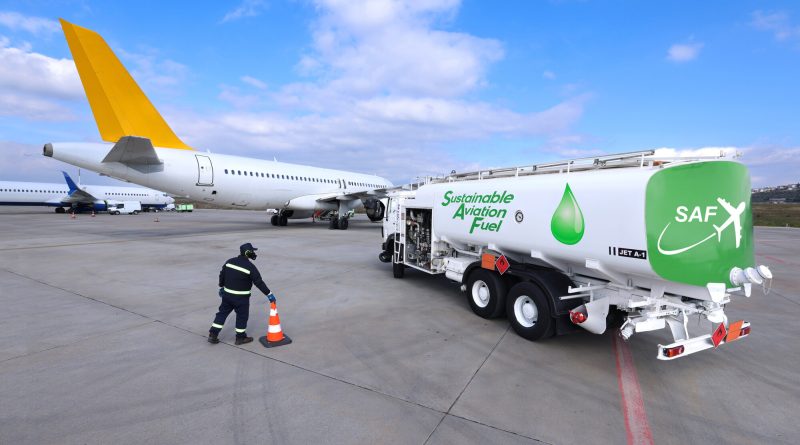
Why Europe is pulling ahead on sustainable aviation fuel
Subscribe to our free newsletter today to keep up to date with the latest renewable energy news.
European airlines are moving faster than their US rivals in the use of sustainable aviation fuel, giving the region an early lead in one of aviation’s main decarbonization efforts.
The gap became clear in 2025. IAG sourced 3.3% of its jet fuel from sustainable aviation fuel, or SAF, while Air France-KLM reached 2.9% and Ryanair reached 2%. Major US airlines were generally between 0.3% and 1%.
IAG alone bought more than 99 million gallons of SAF, slightly more than the roughly 97 million gallons used by major US carriers combined.
The figures point to a wider shift in the new energy market. Europe is using regulation to create demand for cleaner aviation fuel before costs fall to levels that can compete more closely with conventional jet fuel.
That matters well beyond airlines. Rising SAF demand could support investment in renewable fuels, hydrogen, renewable power and carbon management. It could also test whether policy can help a new fuel market move from limited production to wider commercial use.
Mandates are creating demand that voluntary markets have struggled to deliver
Europe’s lead is closely tied to policy.
EU rules require SAF to account for at least 2% of aviation fuel supplied at covered airports from 2025. The target rises over time, reaching 70% by 2050. The regulation also sets a separate requirement for synthetic aviation fuels from 2030.
The UK is following a similar path. Its SAF mandate began at 2% in 2025 and increased to 3.6% in 2026.
The US has taken a different approach. Federal policy has focused more on tax credits and production incentives rather than a nationwide blending mandate.
That difference helps explain why European airlines are using more SAF today.
For producers, mandates provide a clearer base level of future demand. This can give developers more confidence when considering plants that require large amounts of capital and long development periods.
The model also has limits.
SAF remains far more expensive than conventional jet fuel. Industry estimates often put the cost at two to three times that of fossil-based fuel, depending on the feedstock, production route and location.
Those higher costs must eventually be absorbed by airlines, passengers, fuel suppliers or governments. Regulation can create demand, but it cannot remove the cost gap on its own.
Europe is therefore becoming an important test for the wider energy transition. Policy can establish demand quickly. The harder task is building enough supply to lower costs and support long-term growth.
Europe’s lead does not mean the supply problem has been solved
SAF still accounts for a very small share of global aviation fuel use.
IATA expects worldwide SAF production to reach about 2.4 million metric tons in 2026, equal to roughly 0.8% of total jet fuel demand. That compares with about 1.9 million metric tons and 0.6% in 2025.
Strong percentage growth is therefore starting from a low base.
BloombergNEF estimates cited in the original report suggest SAF output could increase sixfold by the end of the decade while still meeting only about 3.5% of global jet fuel demand.
The challenge goes beyond building more plants. Feedstock supply is also limited.
Much of today’s commercial SAF depends on materials such as used cooking oil and animal fats. These resources are finite and already serve other energy and industrial markets.
As demand rises, competition for feedstocks could push costs higher and increase pressure on producers to develop other production routes.
Synthetic SAF, often called e-SAF, is one option. It can be produced using renewable electricity, hydrogen and captured carbon dioxide. That connects aviation fuel demand with a much wider part of the new energy sector.
Yet the economics remain difficult. Lufthansa has said e-SAF can cost as much as 10 times more than conventional jet fuel.
For hydrogen developers and renewable power companies, this cost gap presents both a barrier and a commercial signal. Lower electricity costs, larger electrolyzers and more efficient production processes could become important factors in the next stage of SAF development.
The next SAF race will be about production capacity
Europe may lead in SAF consumption today, but the market is becoming more international.
Singapore is introducing a SAF levy for departing flights in 2026, while South Korea plans a 1% SAF requirement for international departures from 2027.
Other governments are also considering how quickly to move airlines and fuel suppliers toward lower-carbon alternatives.
That could change the competitive picture.
If more countries introduce mandates or similar demand measures, the main constraint may shift from finding buyers to securing enough certified fuel at an acceptable price.
This would increase the importance of production capacity, feedstock supply, renewable electricity and hydrogen infrastructure. It could also increase competition between regions seeking to attract new fuel projects and the investment that comes with them.
Europe’s early lead shows that regulation can change purchasing behavior. It does not yet show whether SAF can reach the scale and price aviation needs.
For the new energy sector, that will be the larger test. Airlines may be the end customers, but the next stage of the market will depend on producers that can supply lower-carbon jet fuel reliably, at scale and at a price the industry can sustain.
Source