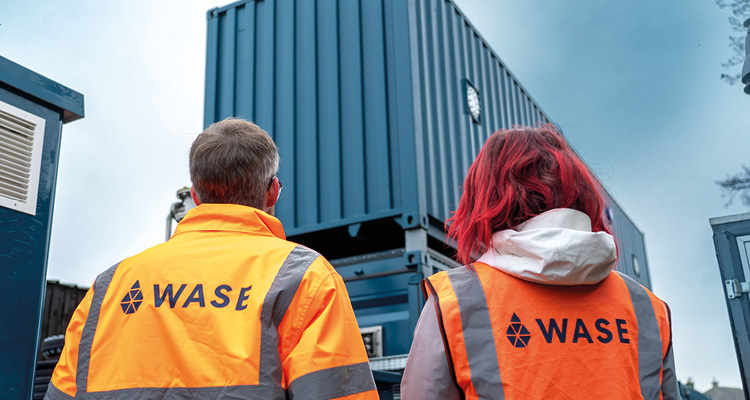
WASE’s electrode-enhanced reactors could deliver 25 percent more energy from existing digestors

When we last spoke with David White, Vice President of Sales, about WASE’s waste-to-energy technology in 2025, the company was looking to build upon its existing applications and diversify into new markets. Over the last 12 months, WASE has certainly achieved these goals, having scaled its reactors tenfold, proved 25 percent energy gains, and entered the US market. The company has also expanded into renewable natural gas (RNG) applications to diversify the applications of its pioneering technology.
“We’ve been experiencing considerable growth in terms of commercial production, product development, and market expansion,” David opens. “Our pipeline has grown in the industrial wastewater sector, and we’ve benefited from market pull in the RNG space. Driven principally by the European market’s drive for energy sovereignty, especially in the wake of the Russia-Ukraine conflict, public policy incentives are stimulating local biogas production and attracting private investment in anaerobic digestion (AD) capacity.”
Diversified technology
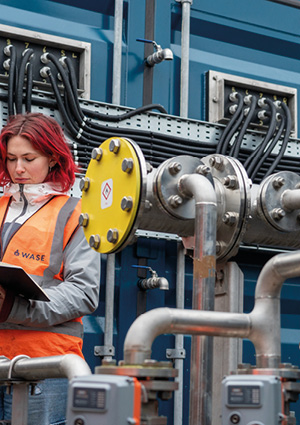
WASE gains from both sides of this market shift, as its electrode-enhanced technology increases the economic performance of existing AD assets while making new greenfield sites more financially viable. Based on a modular electro-methanogenic process, the company’s solutions not only boost energy production, but also treat water up to ten times faster and have a 70 percent smaller footprint when compared with traditional AD processors.
To unlock opportunities in the RNG market, WASE had to develop a process for building much larger reactors. “Previously, our technology was containerized to suit the higher flow of liquid waste streams from industrial wastewater applications,” David explains. “However, RNG substrates are higher in solids but far greater in volume, meaning we redesigned the technology to handle both higher solids concentration and increased volumes. In fact, we’ve increased our tanks tenfold, constructing tanks with a reactor volume of 500 cubic meters.”
In terms of projects, WASE’s Hepworth Brewery installation continues to convert prospective customers across the UK’s industrial wastewater market. “Hepworth Brewery is a genuinely world-class application of WASE technology, and it’s an impactful reference point for customers,” David says. “Customers can see how we treat variable strength brewing waste and turn it into energy to run the facility while also discharging clear water to the environment in a less than two-day retention time.”
Proof in numbers
More recently, WASE has fitted a satellite reactor to an AD facility operated by ENGIE in North Devon, England. The trial takes the same feed, at the same volume and temperature, and processes it through both a WASE electro-methanogenic reactor (EMR) and a conventional AD satellite reactor. Initial results have demonstrated more than a 25 percent increase in energy yield using the WASE EMR versus the non-electrode-enhanced reactor.
“Our test project in Devon validates our claims and provides credibility to the data,” David states. “We’re not just saying WASE increases energy yield – we’re proving it. The implications reach well beyond Devon, as higher yields drive strong internal rates of return that investors demand of energy-generating assets, offering a route to greater energy security. If we could unlock 20, 25, or even 30 percent more gas from our existing assets, we’d be adding a considerable amount of gas production without the need for building new sites or acquiring more feedstock.”
Across the Atlantic, WASE has established a US entity and is quickly learning the market dynamics. “The US market differs hugely from Europe,” David shares. “With vast geography and few drain networks connecting production facilities to municipal treatment plants, waste haulage is commonplace but comes at a high cost. Rather than policy incentives, the federal government operates a voluntary carbon market that rewards those who convert carbon-intensive byproducts into biogas. Producers can stack the value to not only remove the carbon associated with hauling but also create carbon-plus green gas to make it financially compelling, meaning the US market is much more market driven rather than policy driven as seen in Europe.”
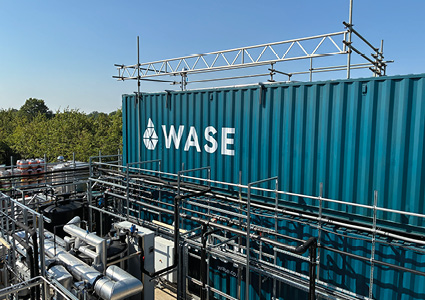
The company’s first US project is underway in partnership with a US-based energy management company, Kimmeridge. “We’ve identified an opportunity to target chicken processing waste, which is highly carbon-intensive and difficult for municipal plants to handle,” David explains. “At a facility in Arkansas, we’re running a six-month, full-scale pilot mirroring our project in North Devon. If the pilot is successful, we’ve signed a pre-order agreement worth over $20 million to mobilize this concept across further large facilities with the same company.”
Unlocking data
WASE Intelligence, the company’s machine learning platform, underpins all operations, and the platform has moved from lab concept to a deployed product over the last year. “We have effectively become a communication channel for the microbes to better understand how to ensure optimal conditions,” David says. “Combined with sensor data such as flow rate, temperature, and pH, machine learning models interpret conditions in real time and trigger interventions such as dosing nutrients, slowing pumps, or raising alarms. Where conventional AD plants rely on lagging measures, we have much more control over system uptime, optimization, and performance, which not only unlocks more energy but also helps us operate a more reliable and resilient system.”
As WASE continues to grow, the focus for 2026 remains on the closing of its Series A investment round. “The funding will bring in new investors and directors to fuel our growth and further technology developments,” David shares. “It will also trigger around 20 additional roles, mostly in technical areas like process, electrical, chemical, and field engineering.
“Longer-term, we’re looking to grow the RNG arm of the business across retrofit and greenfield sites, and I expect WASE to become a commonplace solution in both the EU and US RNG markets in the future,” David concludes. “We’ll also continue to expand WASE Intelligence and scale toward grid-level applications as we continue to evolve.”