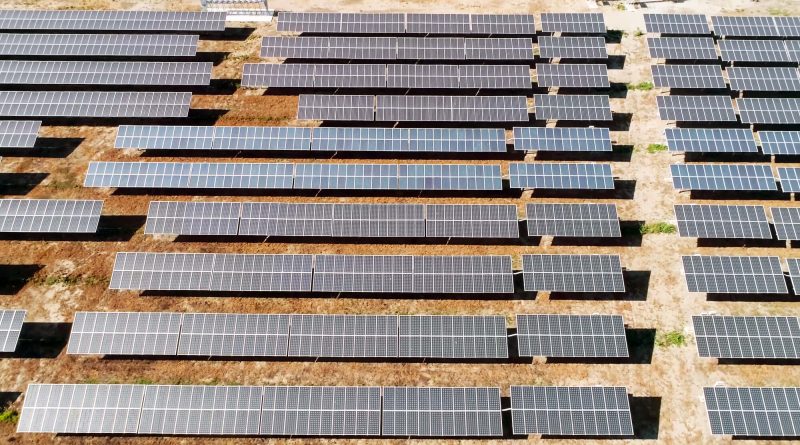
Solar generation forecast to rise 21% across the US in 2026
Subscribe to our free newsletter today to keep up to date with the latest renewable energy news.
US solar generation is expected to rise 21% in 2026 as electricity demand grows and developers add record levels of new power capacity.
The US Energy Information Administration expects solar generation to increase by a further 18% in 2027. That would make solar one of the fastest-growing sources of electricity on the US grid over the next two years.
The forecast comes as electricity use is also rising. Data centers, new manufacturing facilities and commercial customers are adding demand after years of slower growth in US power consumption.
Natural gas generation is expected to rise 2% in 2026 and 1% in 2027. Wind generation is forecast to increase 7% this year and 5% next year. Coal generation, meanwhile, is expected to fall 8% in 2026 and 6% in 2027.
The figures point to a power market in which new solar capacity will play a larger role alongside gas, wind, nuclear power, storage and other sources.
For utilities and large electricity users, this raises a wider question. The US must add enough generation, storage and grid capacity to meet higher demand while keeping the power system reliable.
Solar is taking a larger share of new US power supply
The volume of new capacity due to join the grid shows the scale of the change.
Developers planned to add 86 GW of utility-scale generating capacity in 2026, according to EIA data. If completed, that would be a record.
Solar represents 51% of the planned additions. Battery storage accounts for another 28%, while wind represents 14%. Developers planned 43.4 GW of new utility-scale solar capacity alone.
That buildout helps explain the projected 21% rise in solar generation this year.
It also shows why storage is becoming more closely linked with solar development. Solar plants produce electricity when sunlight is available, while demand follows a different daily pattern. Batteries can store some excess power and release it later when demand is higher.
Other generation sources will remain important. The EIA expects natural gas to provide about 40% of US electricity generation in both 2026 and 2027. Solar’s share is expected to rise from 8% in 2026 to 9% in 2027.
The shift points toward a more varied power system rather than the rapid replacement of one source by another.
That has practical implications for utilities, manufacturers and other large users. Adding generation is only part of the task. New projects also need grid connections, transmission capacity and enough flexibility to balance changes in supply and demand.
Those requirements become more pressing as solar output and total electricity use increase at the same time.
Data centers and manufacturing are changing the demand equation
The demand side of the power market is also changing.
The EIA expects US electricity generation to reach record levels in 2026 and 2027. Commercial demand is an important part of that increase, with data centers adding large new loads in several regions.
Manufacturing is placing further pressure on the grid as new industrial projects seek electricity connections.
This marks a change from much of the past two decades, when US electricity demand grew slowly.
Some grid operators are now planning for sustained increases in consumption.
PJM, which manages the power system across all or part of 13 states and Washington, D.C., is expected to account for nearly 45% of the growth in total US generation in the EIA forecast. Natural gas is expected to provide much of the region’s additional generation in 2026.
Regional differences will matter.
The fastest growth in generation does not always occur where electricity demand is increasing most rapidly. The US power system is divided among regional grids with different generation mixes, transmission networks and project pipelines.
National solar growth figures therefore tell only part of the story.
Companies planning factories, data centers and other power-intensive facilities may need to place greater weight on regional electricity conditions. Available generation matters, but so do connection times, transmission limits, local prices and the speed at which new capacity can enter service.
As power demand increases, energy availability is likely to play a larger role in decisions about where companies build and expand.
Texas and the Midwest show where solar growth is concentrated
Some of the largest increases in solar generation are expected in Texas and the Midwest.
The EIA forecasts that solar generation in the Electric Reliability Council of Texas, known as ERCOT, will increase by 18 billion kWh in 2026. It expects another 20 billion kWh increase in 2027.
The Midcontinent Independent System Operator, or MISO, is expected to add 13 billion kWh of solar generation in 2026 and another 11 billion kWh the following year.
Texas is also at the center of planned capacity development.
About 40% of the utility-scale solar capacity developers planned to add nationally in 2026 was scheduled for Texas. More than half of planned US utility-scale solar capacity was concentrated in Texas, Arizona, California and Michigan.
Battery investment follows a similar pattern. Developers planned to add 24 GW of utility-scale battery capacity during 2026, with Texas accounting for more than half of that total.
This close relationship between solar and storage reflects the operational needs of a grid with more variable generation.
Higher solar output can increase the supply of electricity during sunny periods. Storage can move some of that power into later hours, while transmission can shift electricity between areas with different supply and demand conditions.
For businesses, national renewable energy investment figures may be less useful than local grid conditions. A region can have strong generation growth and still face limits caused by transmission constraints, connection delays or rapid increases in demand.
Solar growth is becoming part of a wider power market shift
The US trend is part of a broader change in global electricity markets.
The International Energy Agency expects global solar PV generation to increase by around 600 TWh in 2026, broadly matching the record increase recorded in 2025.
Solar is expected to overtake wind in 2026 and become the world’s second-largest renewable source of electricity after hydropower. Renewable generation as a whole is also forecast to overtake coal-fired generation globally this year.
At the same time, electricity consumption continues to rise.
The IEA expects demand in the US and European Union to increase by close to 2% in 2026, with faster growth forecast in China and India.
That creates a different planning challenge from the period when electricity demand was largely flat.
More generating capacity must be built while grids are expanded, storage increases and other power plants remain available where they are needed to maintain supply.
For industrial companies, energy developers and utilities, the projected 21% rise in US solar generation is therefore part of a larger change in the power system.
Solar is set to provide more electricity, but the business impact will depend on whether transmission, storage and grid connections can expand fast enough to keep pace with both new generation and rising demand.
Source