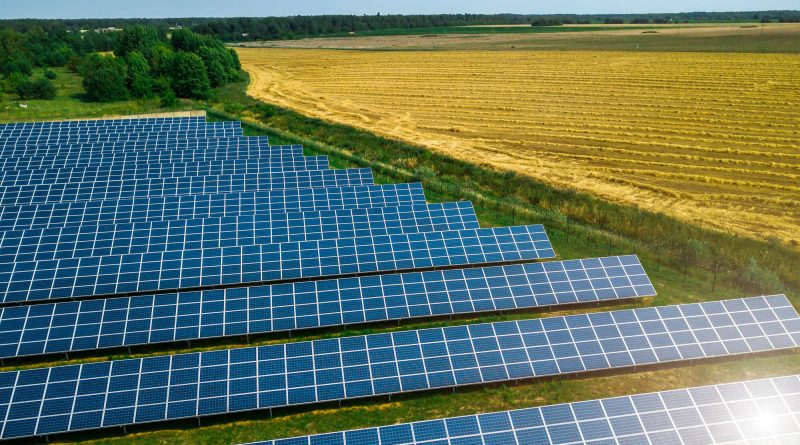
Solar becomes EU’s largest power source

Subscribe to our free newsletter today to keep up to date with the latest renewable energy news.
Europe’s solar sector reached another milestone in June after becoming the European Union’s largest source of electricity for the month, highlighting how rapidly renewable generation is reshaping the region’s energy mix. Yet the achievement also signals the beginning of a new challenge. Producing more renewable electricity is no longer the biggest hurdle. Moving, storing and managing it efficiently has become the next priority.
Solar generated approximately 52 terawatt-hours (TWh) during June, accounting for a record 25% of EU electricity production. It overtook nuclear, gas, wind, hydropower and coal as the bloc’s largest single source of power, continuing a rise from just 10% of electricity generation during the same month in 2021.
The figures underline the pace of Europe’s energy transition, supported by years of investment in utility-scale solar farms, rooftop installations and supportive policy frameworks. They also demonstrate how quickly renewable energy has evolved from an emerging technology into a cornerstone of Europe’s electricity system.
Solar deployment has moved faster than the power system around it
The latest figures represent more than another record month for renewable energy. They illustrate how rapidly solar generation has expanded across Europe.
The EU added more than 65 GW of new solar capacity during 2025, helping push generation to new highs throughout the first half of 2026. Eighteen member states recorded their highest monthly solar production, while longer daylight hours and higher electricity demand during early summer allowed solar to outperform every other generation source.
Unlike conventional power stations, solar capacity can be deployed across multiple scales simultaneously. Large utility projects continue to dominate overall capacity additions, while commercial rooftops, residential systems and community projects collectively contribute significant volumes of generation. This distributed model has enabled capacity to expand much faster than many traditional generation technologies.
The speed of deployment, however, has exposed weaknesses elsewhere in Europe’s electricity infrastructure.
Transmission networks, interconnectors and battery storage have not expanded at the same pace as renewable generation. In many regions, developers continue to face lengthy grid connection queues, while electricity markets increasingly experience periods of abundant daytime supply followed by steep increases in demand during the evening.
These conditions create price volatility, occasional negative wholesale electricity prices and increasing levels of renewable curtailment, where available solar generation cannot be fully absorbed by the grid.
The challenge facing policymakers has shifted. Building renewable capacity remains important, but maximizing the value of that generation increasingly depends on the infrastructure surrounding it.
Germany, Spain and Poland illustrate different paths to solar growth
The June figures also demonstrate that Europe’s solar expansion is no longer concentrated in just one or two markets.
Germany continued to lead the continent, with solar providing about 36% of national electricity generation during the month. Decades of investment in both utility-scale projects and distributed rooftop systems have produced one of the world’s most mature solar markets. More recently, widespread adoption of plug-in balcony solar systems has broadened participation among apartment dwellers and urban households, complementing larger commercial installations.
Spain has followed a different model. Utility-scale solar developments, abundant sunshine and strong renewable investment have enabled solar to account for about 34% of electricity generation during June. Combined with significant wind capacity, Spain has become one of Europe’s strongest examples of how renewable generation can reduce dependence on imported fossil fuels while increasing domestic energy security.
Poland represents one of the most notable transformations. Traditionally associated with coal-fired electricity generation, the country has rapidly expanded its photovoltaic capacity over the past five years. Solar supplied about 24% of Polish electricity during June, illustrating how renewable technologies are gaining ground even in markets historically dominated by conventional generation.
Although each country has followed a different investment strategy, they share a common objective. Expanding renewable electricity is helping reduce exposure to volatile fuel markets while improving long-term energy resilience.
The next solar bottleneck is flexibility, not generation
As renewable penetration increases, the conversation is moving beyond generation capacity toward system flexibility.
Electricity must be consumed as it is produced unless it can be stored. Solar output typically peaks during the middle of the day, while residential and commercial demand often rises later in the afternoon and evening. The mismatch creates growing pressure on electricity networks.
Battery storage offers one solution by shifting surplus daytime generation into periods of higher demand. Grid-scale batteries are expanding rapidly across Europe, while residential battery systems are becoming increasingly common alongside rooftop solar installations.
Flexible demand will also play an increasingly important role. Industrial facilities, manufacturing plants, logistics operators and data centers may be able to schedule energy-intensive activities during periods of abundant renewable generation, reducing pressure on the grid while lowering electricity costs.
Cross-border electricity trading, smarter transmission infrastructure and digital demand-response technologies will also become increasingly valuable as renewable generation continues to grow.
Without these complementary investments, additional solar capacity alone will not deliver its full economic or environmental potential.
Solar’s commercial value will depend on what Europe builds next
June’s record confirms that Europe has largely solved one side of the renewable energy equation. Solar generation is no longer a niche contributor to the electricity mix. It has become one of the continent’s dominant power sources.
The next phase of Europe’s energy transition will be defined less by the number of solar panels installed than by the ability of electricity systems to integrate them efficiently.
Investment priorities are already beginning to shift toward battery storage, transmission upgrades, smarter electricity markets and greater flexibility across industrial demand. These developments will determine whether record renewable generation translates into lower costs, improved energy security and continued emissions reductions.
Solar’s rise to the top of Europe’s electricity mix is unlikely to be remembered simply as another renewable energy milestone. It may instead mark the point at which Europe’s energy transition entered a more complex phase, where infrastructure, market design and system flexibility become just as important as generating clean electricity.
Source