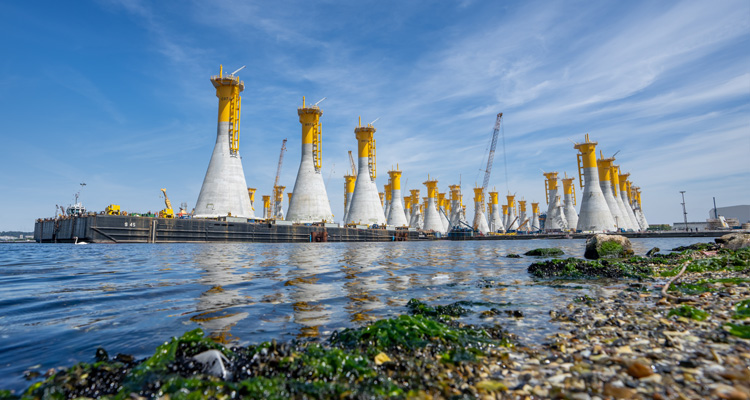
Skyborn Renewables advances large-scale offshore wind projects, focusing on affordability, standardization and energy security
When Skyborn Renewables (Skyborn) acquired the offshore division of another developer, CEO Patrick Lammers inherited an industry challenged by excessive lease prices, unproven technology bets and projects earmarked for construction without visible progress. His response was to instill financial and operational discipline anchored in a clear belief that offshore wind must become a reliable, commercially viable pillar of a decarbonized energy system.
Today, Skyborn operates with a lean structure while positioning itself as a fully integrated offshore wind infrastructure platform, covering the full lifecycle from development to construction and operations. The company standardizes key elements of every offshore wind farm and targets regular final investment decisions (FIDs), ensuring continuity across projects and avoiding supply chain disruption.
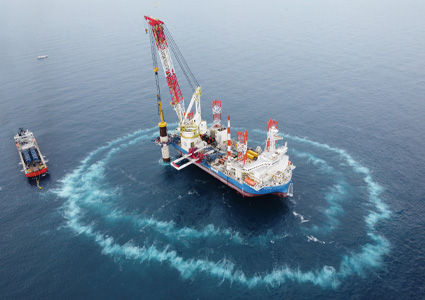
Operating assets span the US, France, Germany and Taiwan, while development activities focus on mature markets in Europe or APAC – markets where disciplined execution can unlock long-term value.
“We develop, engineer, construct, operate and own wind farms,” Patrick explains. “We are a very tight knit but also very lean organization, and we’re well funded by our owners, GIP by BlackRock. Our ambition is to be the quickest and leanest platform in offshore wind”
Gennaker
A flagship project for Skyborn is Gennaker, located in the German Baltic Sea. “Gennaker is almost one gigawatt and fully engineered,” Patrick says. “The project is expected to reach FID this summer. We have contracted most of the offtake, which is critical for a merchant wind farm, and we are targeting commercial operation by the end of 2028.”
Beyond its scale, Gennaker reflects Skyborn’s industrial approach. Patrick explains the company focuses on proven technologies and repeatable project design, typically deploying 15 MW fixed-bottom turbines in wind farms ranging ideally from 750 MW to 1.2 GW. “Floating turbines are not for us,” he states. “We may reconsider once they are economically viable.” This standardization reduces complexity and strengthens predictability across projects; core to Skyborn’s strategy of delivering projects on time, on scope, and on cost.
Central to this model is a rigorous approach to site selection. Skyborn applies a structured framework that prioritizes market earning potential (MEP), including seabed conditions, grid connection availability, and regulatory stability. Financial discipline is equally critical. “Energy is a commodity,” Patrick notes. “You cannot afford to be frivolous. The industry is maturing, and discipline is returning. We are industrializing offshore wind, meaning we are creating a production system that enables us to deliver one project after another.” This reflects Skyborn’s broader mission: to scale offshore wind responsibly by focusing on proven technologies, mature markets, and disciplined execution.
Despite regulatory uncertainty and market challenges, Skyborn remains confident in the long-term outlook.“There’s enough market for everyone” Patrick says. “We deliver CO₂-free electricity bringing both climate benefits and energy security. That combination makes offshore wind a compelling investment case. At the same time, the company takes a pragmatic view of the energy transition. Offshore wind will play a central role, alongside solar, onshore wind and, in the near term, other sources.
“Societies need reliable and affordable energy systems. We need an honest conversation about costs, particularly the growing cost of grid infrastructure. Projects must make sense not only individually, but within the overall system.”
Skyborn’s immediate priority for 2026 is progressing Gennaker to FID, alongside selectively acquiring new projects to secure its development pipeline into the 2030s. “Our aim is to maintain a focused organization,” Patrick explains. “We are building a healthy company delivering reliable energy while generating strong returns for shareholders. That balance is essential for long-term success.”
Looking ahead, Skyborn anticipates further consolidation across the offshore wind sector. “There will be fewer players, greater financial discipline and clearer frameworks,” Patrick concludes. “Governments need to ensure that markets remain investable. If that happens, offshore wind can deliver at the scale required.”
Bénédicte Bergeaud, Senior Director of Global Corporate Affairs at Skyborn, adds: “When looking at the next five years, one of the defining trends will be the maturation and industrialization of offshore wind. The sector has evolved from a phase of innovation towards one of disciplined execution. Standardization, careful market selection and financial rigor will determine which projects – and ultimately companies – succeed.”