
Paul Warley on how solar is scaling in space despite supply chain challenges

SpaceX’s recent June IPO initially reached a $2 trillion valuation milestone and projections say that SpaceX revenue will hit $322B by 2030. Blue Origin and other space companies are likely to follow suit due to the success and interest in the general market. Investing in space-based technologies, and specifically in Low-Earth orbit (LEO), are rising in popularity as a profitable place to solve the ongoing energy demand with technologies like solar panels in space and orbital AI data centers. LEO is also seen as a forward-looking answer to provide reliable communications for commercial and defense purposes through satellites.

To drive this strong defense, communication, space exploration expansion, and supply the energy expectations on Earth, hundreds more megawatts (MW) of power capacity from solar panels in space are needed to reach this demand and power space crafts.
A decade ago, space only needed about four-to-six MW of power generated to operate because the lineup of galactic players was so low. Solar power is now the clear driving force behind this energy expansion, while significant growth in both domestic and international supply chains has enabled the evolution of solar panels from four MW-scale projects to deployments of hundreds of megawatts.
The challenges to reach rising power expectations
With roughly 100 MW of combined solar capacity orbiting in space today, 90 percent of which comes from SpaceX technology alone, we’ve come a long way from the three MW generated in space, but we’re still a long way to hit the expectation of hundreds of MW. For context, 100 MW is comparable to a single, mid-sized solar farm in middle America. Meeting that demand will require significantly more space solar capacity.
Using LEO to its full advantage is essential, as its proximity to Earth enables higher data speeds for satellites, while offering easier launch requirements for solar panels and other space technologies.
Space debris, or space junk, is a huge problem. These human-made, non-functional objects (often broken pieces from defunct satellites) orbit Earth at extreme speeds; even small pieces can be destructive. LEO houses over hundreds of thousands of pieces of debris. Kessler Syndrome, proposed by NASA scientist Donald Kessler in 1978, describes a scenario in which collisions generate even more debris, multiplying the problem and making LEO a dangerous place for spacecraft and solar arrays.
Commercial space players plan to launch thousands more satellites into our already-crowded LEO, exacerbating Kessler’s concern. Instead of designing vehicles that can avoid debris, developers should focus on solar innovations that can withstand impact instead. A more resilient space PV panel is key to continuing with the industry’s expected growth.
Space solar panel progression
Solar panels need specialized glass and raw materials such as copper, silicon, and gallium arsenide (GaAs), as well as photovoltaic cells to convert sunlight into electricity. And because these panels are going to space, virtually every component must be engineered and qualified to withstand harsh conditions, including radiation exposure, extreme temperature swings, and launch vibration, while meeting exceptionally high reliability standards.
Because of this, the space solar supply chain is far more specialized than its terrestrial solar counterpart. Space solar cells are produced at lower volumes than traditional solar cells, and there are far fewer suppliers available. So, when supply chain issues arise, it becomes much more difficult to find alternate materials for solar components, since the space solar cells are expected to perform to very specific metrics that have been established through previous testing. One cannot simply swap out one material for another when the supply chain is disrupted.
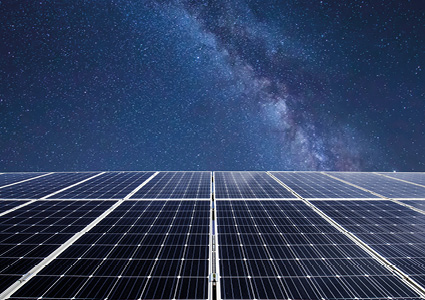
This situation gets even trickier when taking the growing demand for reliable space power generation into account. As commercial space entities aim to further populate LEO with more expansive satellite constellations, there will be even more reliance on space solar technology. Any issues that impact this fragile supply chain situation could end up stalling crucial mission timelines.
With this in mind, the US is committed to strengthening its domestic solar panel supply chain to reduce reliance on foreign nations for critical materials needed to produce this technology. Bolstering our domestic supply chain is vital to ensuring that our space programs have continuous access to the power generation technologies they need to carry out their lofty mission goals.
In March 1958, the first solar array in space was launched on the US satellite Vanguard 1. Since the 1950s, solar power evolution has progressed due to technological breakthroughs in silicon, panel placements, temperature resistant advancement, and the overall durability of these panels. In addition to using silicon, scientists have discovered that adding a layer of minerals known as perovskites can dramatically improve panel efficiency to capture more light and therefore produce more energy.
From this point, power demands for space vehicles increased quite a bit, pushing innovators to begin coming up with ways to increase space solar capabilities and resiliency without adding excessive weight. There are now solar PV solutions that are lightweight and flexible, which can be bent and folded without producing any space junk, when hit. These panels don’t shatter if struck by orbiting debris, making it a more secure choice long-term. There are also options such as the solar sail system that use the pressure of light instead of photovoltaics. Resilient technologies for outer space innovation build-out is vital for growth and progression.
Paul Warley
www.ascentsolar.com
Paul Warley is the CEO of Ascent Solar. Before joining Ascent Solar, he started Warley & Company LLC in 2015 and was the president from 2015 to 2022, offering strategic consulting, executive management services, capital advisory, and M&A to middle-market companies in the service, construction, technology, oil & gas, clean energy, food, retail and green-building sectors.