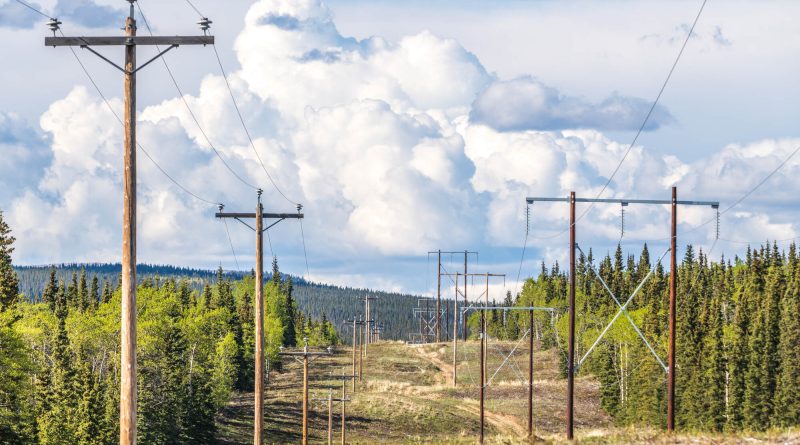
Canada announces record C$70 billion clean energy investment
Subscribe to our free newsletter today to keep up to date with the latest renewable energy news.
Canada has announced nearly C$70 billion in clean energy projects that could create one of the country’s largest construction programs in decades.
The agreement between the federal government, Quebec and Newfoundland and Labrador includes an expansion of the Churchill Falls generating station, development of the Gull Island hydroelectric project and new transmission infrastructure.
Ottawa has committed up to C$10 billion in federal financing and support. Together, the projects could produce 14,000 MW of renewable power, almost three times the current generating capacity at Churchill Falls. The Canadian government estimates they will support 23,000 jobs during construction and add C$31 billion to GDP through the early 2040s.
For construction companies, the significance goes well beyond two hydroelectric developments.
The wider program could create demand for civil engineering, heavy construction, electrical work, roads, transmission lines, worker accommodation and project logistics. It could also support new mining infrastructure across Labrador and Quebec.
That makes the announcement an early sign of where a large share of Canadian infrastructure spending could be directed over the next decade.
The work extends well beyond hydroelectric construction
The two major power projects form the center of the agreement.
Churchill Falls, already one of Canada’s largest generating stations, is due to be upgraded and expanded. Gull Island, farther downstream on the Churchill River, would add another major hydroelectric facility.
The agreement also includes associated transmission lines and the potential for a large onshore wind project in Labrador involving the Innu of Labrador.
For contractors, the supporting infrastructure may be just as important as the generating assets.
The federal government has referred the Labrador Trough Clean Power, Critical Minerals and Infrastructure Corridor to its Major Projects Office. The Labrador Trough contains major iron ore deposits and extends across Newfoundland and Labrador and Quebec.
Several early-stage projects are already linked to the corridor.
They include studies for expanded transmission in Labrador West, transport and energy infrastructure for the proposed Kami iron ore project and pre-construction work on a transmission line and road serving the Lac Knife graphite project.
Another proposal would increase critical minerals handling and rail capacity at Pointe-Noire in Quebec.
This creates a wider construction opportunity.
New power generation can make mining projects more viable, while mining development can support the case for additional roads, railways, transmission and port infrastructure. Each project can therefore create demand elsewhere in the supply chain.
For general contractors and specialist subcontractors, that could mean opportunities that would not normally be classed as renewable energy construction.
Earthworks, concrete structures, electrical systems, tunneling, access roads, substations and logistics facilities could all form part of the eventual program.
The scale also matters.
The investment is valued at nearly C$70 billion, or about US$50.5 billion. Some of the additional electricity would be sent to Quebec, while Hydro-Québec could also sell power into the northeastern US.
That gives the projects an economic role beyond local electricity supply. They could support industrial development while increasing Canada’s ability to move power between provinces and into export markets.
Labor and project capacity could become the harder problem
Large investment figures do not automatically translate into construction at the same pace.
Programs of this size require engineers, project managers, electricians, equipment operators, ironworkers and other skilled trades. They also need heavy equipment, specialist subcontractors and large volumes of construction materials.
Many of those resources are already in demand across Canadian infrastructure, industrial and energy projects.
The government’s estimate of 23,000 construction-phase jobs shows the size of the workforce requirement.
Location adds another challenge.
Much of the proposed work is in Labrador, where large projects can require worker camps, temporary facilities, long-distance supply chains and extensive transport planning. Construction schedules can also be affected by weather and limited access.
These factors make workforce planning an important part of the investment story.
Contractors considering the projects may need to secure skilled workers earlier, build relationships with local and Indigenous businesses and plan equipment and material supply well before major construction begins.
The projects are also likely to compete with other infrastructure programs for the same people and equipment.
That could raise costs or extend schedules if several projects move into construction at the same time.
For owners, this increases the importance of procurement planning. Contract packaging, supplier lead times and coordination between major projects could have a direct effect on delivery.
The size of the opportunity now depends on delivery
The C$70 billion figure makes the agreement significant for Canada’s construction sector, but much of the work has not yet reached the jobsite.
Major projects still need to move through development, engineering, environmental review, permitting, financing and procurement before construction reaches full scale.
Political risk is also a factor.
Quebec Premier Christine Fréchette has acknowledged that the agreement could face opposition after Quebec’s provincial election. For contractors and suppliers, that adds uncertainty over when proposed spending could turn into awarded work.
Ottawa is seeking to reduce some development delays through the Major Projects Office, which is expected to coordinate federal financing, permitting requirements and partnerships with Indigenous communities for the Labrador corridor.
The construction sector should therefore view the announcement as a major prospective pipeline rather than C$70 billion of immediately available contracts.
Even so, its potential scale is difficult to ignore.
If Churchill Falls, Gull Island, transmission expansion and associated mining infrastructure advance, contractors could be looking at a multiyear program spanning power, civil construction, transportation and industrial development.
For construction companies, the main question is whether the industry can supply enough people, equipment and project capacity to build it.
Source